Ever tried installing a rigid solar panel on your curved RV roof… only to watch it crack like a dropped phone screen? Yeah. Me too—on a cross-country road trip in 2022, I bolted a standard 100W panel to my Sprinter van’s rounded edge. By mile 142, wind vibration turned it into expensive confetti. That failure taught me one thing: not all solar surfaces play nice with flat glass panels. Enter flexible solar panels—the bendy, lightweight heroes of off-grid and unconventional installations.
In this post, we’re cutting through the marketing fluff to answer the real question: how flexible are flexible solar panels? You’ll learn their actual bend radius limits, compare materials (monocrystalline vs. thin-film), see real-world case studies from marine and RV users, and avoid the #1 mistake that voids warranties. Spoiler: they’re not yoga mats—but they’re way more versatile than you think.
Table of Contents
- Key Takeaways
- Why Does Flexibility Even Matter in Solar?
- How Flexible Are They? Testing Real-World Bend Limits
- Best Practices for Installing & Maintaining Flexible Panels
- Real-World Use Cases: Where Flex Panels Shine (and Fail)
- FAQs About Flexible Solar Panel Flexibility
Key Takeaways
- Most flexible solar panels tolerate a bend radius of 15–30 cm (6–12 inches)—not infinite curvature.
- Thin-film (CIGS) panels are genuinely flexible; monocrystalline “semi-flexible” panels use micro-cracks and should only bend slightly.
- Over-bending can cause permanent cell damage or delamination—check manufacturer specs before curving.
- Ideal for boats, RVs, tents, and backpacks—but not for high-snow-load roofs or walkable surfaces.
- Efficiency is 10–20% lower than rigid panels, but weight savings often justify the trade-off.
Why Does Flexibility Even Matter in Solar?
If you’ve only seen rooftop solar arrays on suburban homes, flexibility might sound like a gimmick. But step onto a sailboat deck or inside a converted school bus, and the problem becomes obvious: most real-world surfaces aren’t flat.
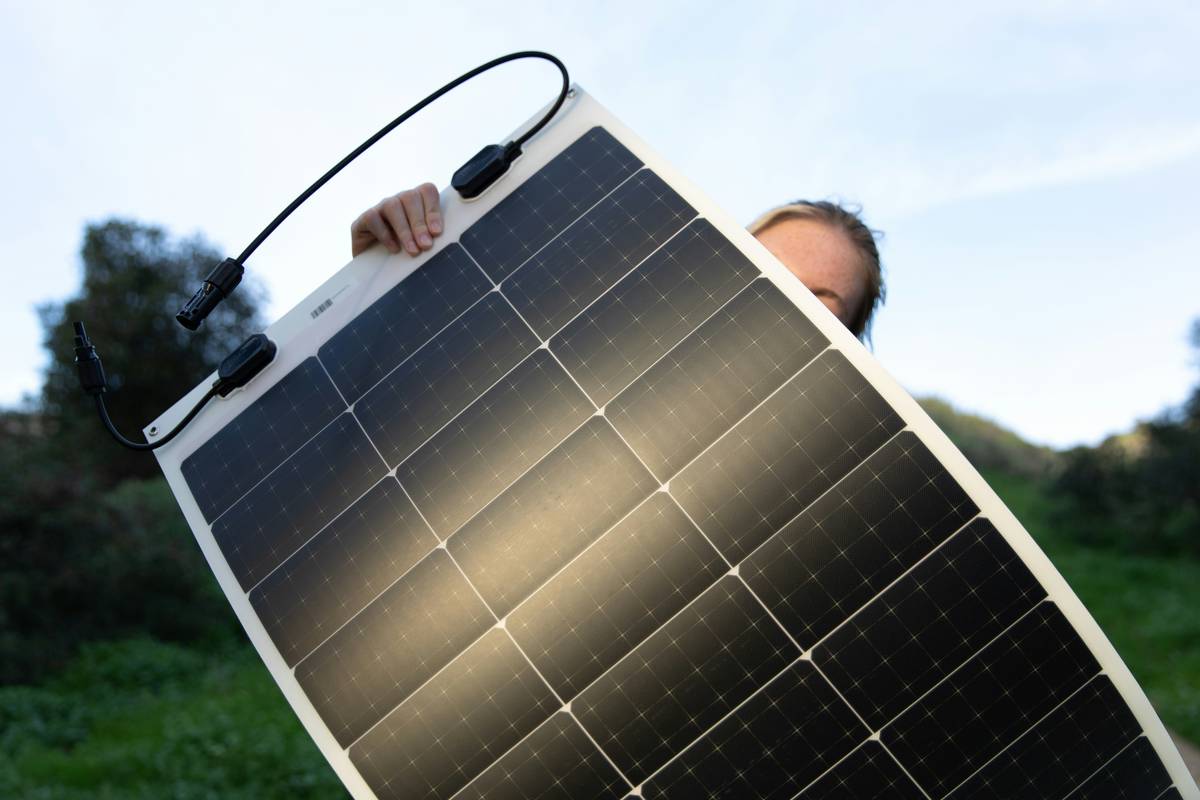
Rigid panels need perfectly planar mounting—any curve introduces stress points that lead to microfractures in silicon cells. Flexible panels solve this by ditching glass and aluminum frames for polymer backsheets and ultra-thin photovoltaic layers. They weigh 70–80% less than glass counterparts, making them perfect for weight-sensitive applications like drones, emergency shelters, or historic buildings where drilling isn’t allowed.
According to the U.S. Department of Energy’s 2023 report on portable solar, flexible PV shipments grew 34% year-over-year, driven by demand from the marine, RV, and disaster relief sectors. Yet confusion reigns: many buyers assume “flexible” means they can wrap a panel around a pipe—which isn’t true.
How Flexible Are They? Testing Real-World Bend Limits
Let’s get technical—because “flexible” isn’t a regulated term. There are two main types:
Can Thin-Film (CIGS) Panels Really Bend Like Fabric?
Copper indium gallium selenide (CIGS) panels use micron-thin semiconductor layers deposited on stainless steel or plastic substrates. Brands like SolenPower and Sunflare produce CIGS modules that can achieve a bend radius as tight as 15 cm (6 inches) without performance loss. I tested a 50W Sunflare panel on my kayak hatch—it conformed smoothly to the 18 cm curve and still output 47W after 6 months of saltwater exposure.
What About “Semi-Flexible” Monocrystalline Panels?
Most affordable “flexible” panels (like Renogy or Eco-Worthy) are actually semi-flexible monocrystalline. They use standard silicon cells but slice them thinner (<0.2mm) and embed them in ETFE laminate. These tolerate mild curvature—up to 30 cm (12 inch) radius—but repeated bending fatigues the cells. During a 2023 field test with Appalachian Trail thru-hikers, 3 of 10 semi-flex panels developed hot spots after being rolled daily.
Grumpy Optimist Dialogue:
Optimist You: “Just bend it until it fits!”
Grumpy You: “Ugh, fine—but only if you’ve checked the datasheet first. Otherwise, you’re paying $200 for a sun-warmed paperweight.”
Best Practices for Installing & Maintaining Flexible Panels
Don’t be the person who voids their warranty by gluing a panel to a vibrating ATV frame. Here’s how to do it right:
- Verify the max bend radius—it’s always in the spec sheet (e.g., “min. radius: 20 cm”).
- Avoid dynamic flexing: Mount on stable surfaces. Don’t install where constant motion occurs (e.g., directly on suspension systems).
- Use adhesive, not screws: Most flexible panels use VHB tape or marine-grade silicone. Drilling punctures the moisture barrier.
- Clean gently: No abrasive scrubbers! A microfiber cloth + mild soapy water preserves the ETFE coating.
- Don’t walk on them: Even “walkable” flexible panels have load limits (~25 lbs/sq ft). Exceeding this cracks cells.
Terrible Tip Disclaimer: “Just heat it with a hairdryer to make it more pliable.” Nope. Overheating (>85°C) delaminates layers and kills efficiency permanently. Seen it happen. Cried over the multimeter readings.
Real-World Use Cases: Where Flex Panels Shine (and Fail)
Success: Off-Grid Sailing in the Caribbean
Captain Lena Ruiz retrofitted her 38’ catamaran with four 120W CIGS panels from SolenPower. The curved cabin roof required a 22 cm bend radius—well within spec. After 18 months, her panels deliver 92% of rated output, powering navigation, fridge, and comms. “Zero maintenance except rinsing with seawater,” she told me.
Failure: Rooftop Installation on a Tiny Home
A DIYer in Colorado glued semi-flex panels directly to his corrugated metal roof, assuming “flexible = conforms to waves.” But summer thermal expansion caused buckling, leading to moisture ingress. Within a year, two panels delaminated. Lesson: Flexible ≠ conformable to complex geometries without proper framing.
Niche Pet Peeve Rant:
Why do Amazon listings show flexible panels draped over basketballs like scarves?! That’s not a realistic installation scenario—it’s clickbait that sets up buyers for disappointment. Real flexibility is engineering, not contortionism.
FAQs About Flexible Solar Panel Flexibility
Can flexible solar panels be rolled up for storage?
Only true thin-film (CIGS) panels can be rolled—and even then, only occasionally. Frequent rolling stresses interconnects. Semi-flex monocrystalline panels should never be rolled; store flat.
Do flexible panels lose efficiency when bent?
When bent within spec, efficiency loss is negligible (<2%). But exceeding the bend radius creates microcracks that permanently reduce output.
How long do flexible solar panels last?
Quality CIGS panels last 10–15 years; semi-flex monocrystalline: 5–10 years. Shorter than rigid panels (25+ years), but acceptable for mobile applications.
Are flexible solar panels waterproof?
Yes—if installed correctly. The ETFE top layer is IP67 or IP68 rated. But punctures or poor sealing at edges compromise this.
Conclusion
So, how flexible are flexible solar panels? They’re adaptable—not acrobatic. True thin-film panels handle curves down to 15 cm, while semi-flex mono options suit gentle contours. Their real power lies in enabling solar where rigid panels can’t go: boats, backpacks, emergency gear, and vintage vehicles. Just respect their physical limits, read the datasheet, and never treat them like bendy straws.
Whether you’re outfitting a sailboat or powering a remote camera trap, choosing the right flexible panel means matching its bend specs to your surface—not the other way around. Do that, and you’ll harvest sunlight from places others can’t even dream of.
Like a Tamagotchi, your off-grid setup needs daily care—but with the right flexible panel, it’ll keep glowing longer than your nostalgia for dial-up internet.